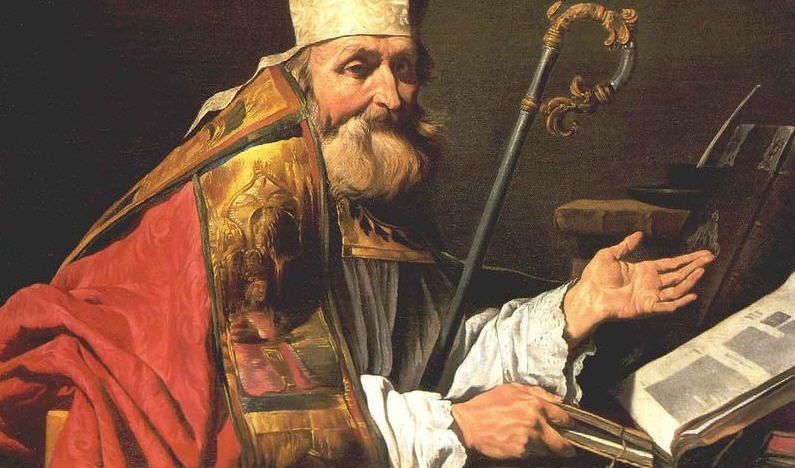
Saint Ambrose - December 7
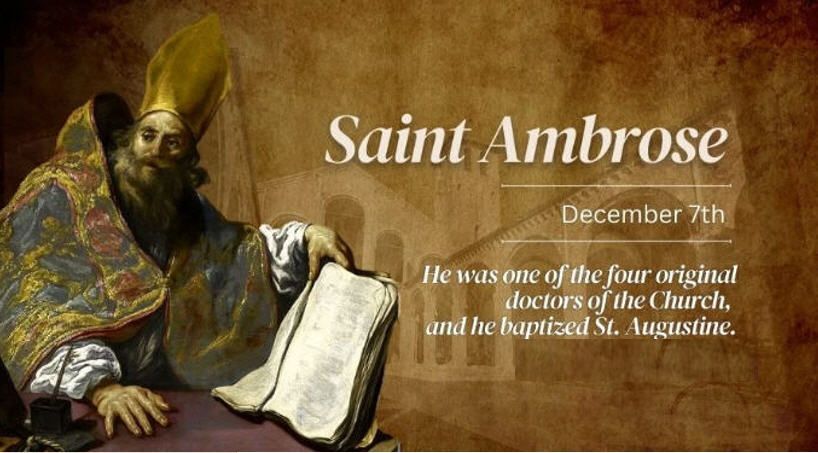
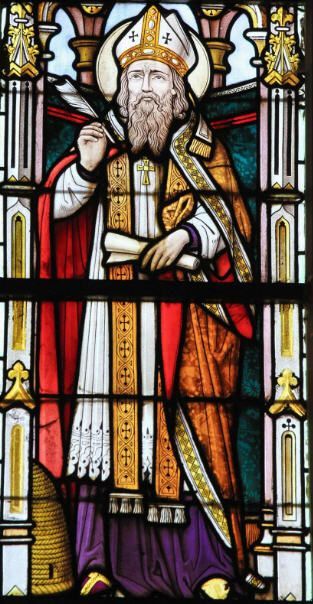
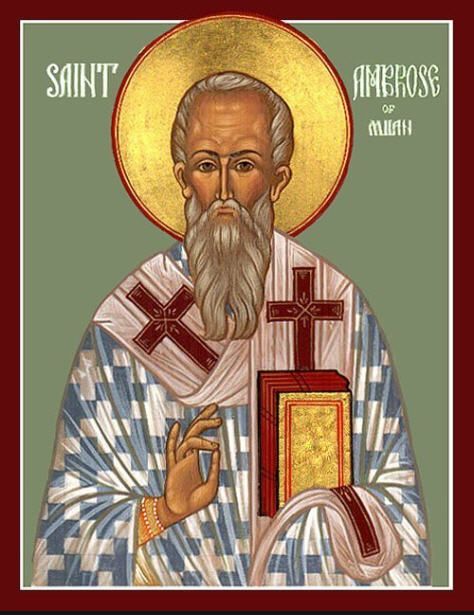
Today the Catholic Church celebrates the memory of St. Ambrose, the brilliant Bishop of Milan who influenced St. Augustine's conversion and was named a Doctor of the Church. Like Augustine himself, the older Ambrose, born around 340, was a highly educated man who sought to harmonize Greek and Roman intellectual culture with the Catholic faith. Trained in literature, law, and rhetoric, he eventually became the governor of Liguria and Emilia, with headquarters at Milan. He manifested his intellectual gifts in defense of Christian doctrine even before his baptism.
While Ambrose was serving as governor, a bishop named Auxentius was leading the diocese. Although he was an excellent public speaker with a forceful personality, Auxentius also followed the heresy of Arius, which denied the divinity of Christ. Although the Council of Nicaea had reasserted the traditional teaching on Jesus' deity, many educated members of the Church – including, at one time, a majority of the world's bishops – looked to Arianism as a more sophisticated and cosmopolitan version of Christianity. Bishop Auxentius became notorious for forcing clergy throughout the region to accept Arian creeds.
At the time of Auxentius' death, Ambrose had not yet even been baptized. But his deep understanding and love of the traditional faith were already clear to the faithful of Milan. They considered him the most logical choice to succeed Auxentius, even though he was still just a catechumen. With the help of Emperor Valentinan II, who ruled the Western Roman Empire at the time, a mob of Milanese Catholics virtually forced Ambrose to become their bishop against his own will. Eight days after his baptism, Ambrose received episcopal consecration on Dec. 7, 374. The date would eventually become his liturgical feast.
Bishop Ambrose did not disappoint those who had clamored for his appointment and consecration. He began his ministry by giving everything he owned to the poor and to the Church. He looked to the writings of Greek theologians like St. Basil for help in explaining the Church's traditional teachings to the people during times of doctrinal confusion. Like the fathers of the Eastern Church, Ambrose drew from the intellectual reserves of pre-Christian philosophy and literature to make the faith more comprehensible to his hearers. This harmony of faith with other sources of knowledge served to attract, among others, the young professor Aurelius Augustinus – a man Ambrose taught and baptized, whom history knows as St. Augustine of Hippo.
Ambrose himself lived simply, wrote prolifically, and celebrated Mass each day. He found time to counsel an amazing range of public officials, pagan inquirers, confused Catholics and penitent sinners. His popularity, in fact, served to keep at bay those who would have preferred to force him from the diocese, including the Western Empress Justina and a group of her advisers, who sought to rid the West of adherence to the Nicene Creed, pushing instead for strict Arianism. Ambrose heroically refused her attempts to impose heretical bishops in Italy, along with her efforts to seize churches in the name of Arianism. Ambrose also displayed remarkable courage when he publicly denied communion to the Emperor Theodosius, who had ordered the massacre of 7,000 citizens in Thessalonica leading to his excommunication by Ambrose.
The chastened emperor took Ambrose's rebuke to heart, publicly repenting of the massacre and doing penance for the murders. “Nor was there afterwards a day on which he did not grieve for his mistake,” Ambrose himself noted when he spoke at the emperor's funeral. The rebuke spurred a profound change in Emperor Theodosius. He reconciled himself with the Church and the bishop, who attended to the emperor on his deathbed. St. Ambrose died in 397. His 23 years of diligent service had turned a deeply troubled diocese into an exemplary outpost for the faith. His writings remained an important point of reference for the Church, well into the medieval era and beyond. St. Ambrose has been named one of the “holy fathers” of the Church, whose teaching all bishops should “in every way follow.”
Saint Frances Cabrini - November 13
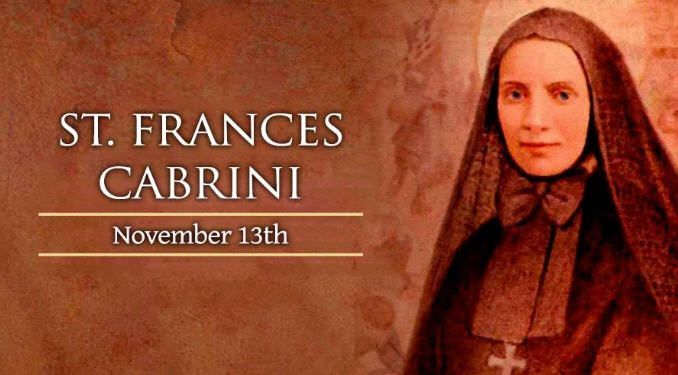
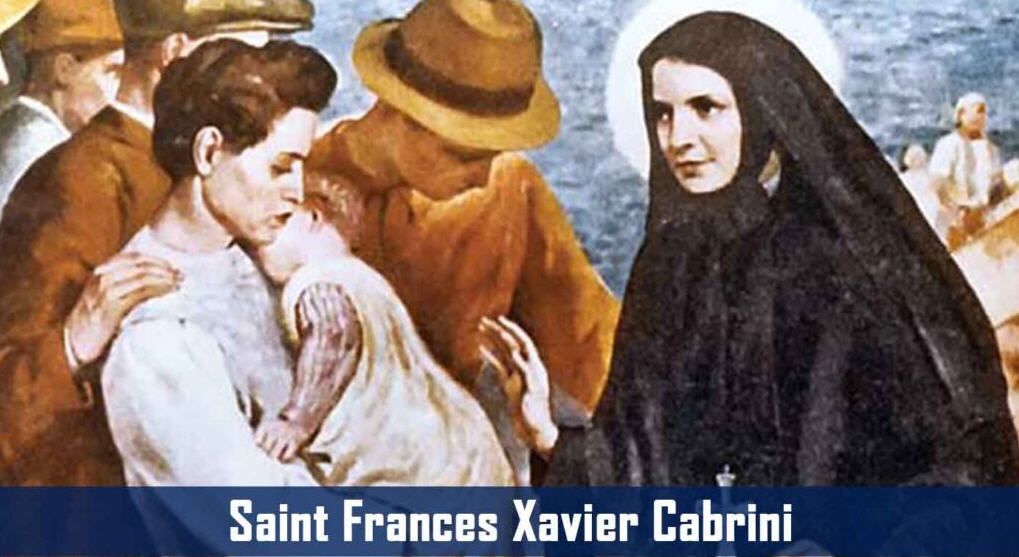
On November 13, the universal Church honors St. Frances Xavier Cabrini, an Italian missionary who spent much of her life working with Italian immigrants in the United States. Mother Cabrini, who had a deathly fear of water and drowning, crossed the Atlantic Ocean more than 30 times in service of the Church and the people she was serving.
St. Frances Cabrini, from a young age, longed to be a missionary in China, but God had other plans for her. Orphaned in Italy before she was 18, she joined the Sisters of the Sacred Heart and took on the name “Xavier” in honor of St. Francis Xavier, the great missionary to the Orient.
At the advice of Pope Leo XIII, who told her “Not to the East, but to the West,” she focused her missionary efforts on the United States. Accepting Archbishop Corrigan of New York's invitation, she came to America and spent nearly 30 years traveling back and forth across the Atlantic Ocean as well as around the United States setting up orphanages, hospitals, convents, and schools for the often marginalized Italian immigrants.
Eventually, St. Frances became a naturalized U.S. citizen. She died in 1917 and was canonized in 1946, just before a new wave of immigrants began to arrive in the U.S.
St. Frances Cabrini is the patron of immigrants.
St. Frances Xavier Cabrini | November 13
Short Bio
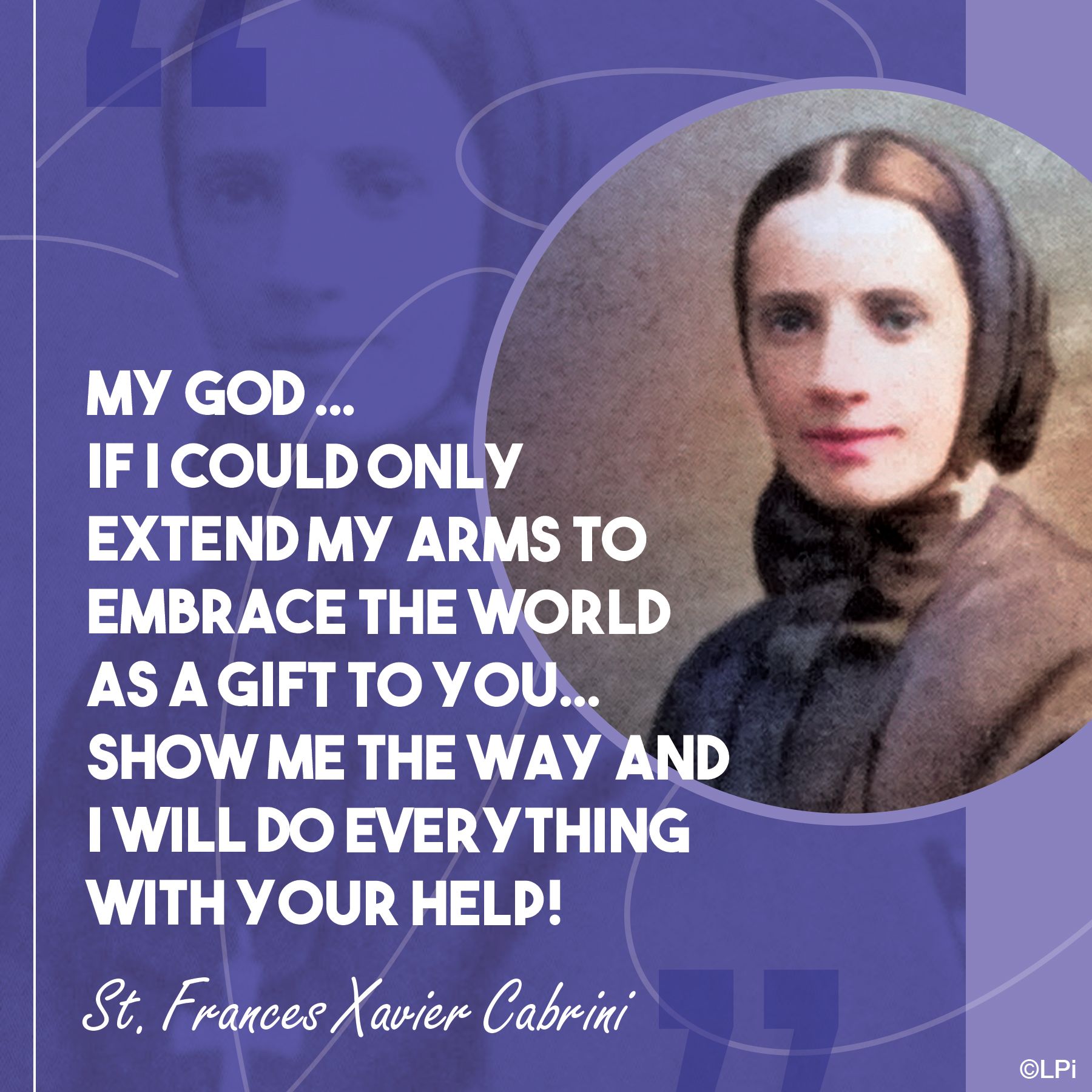
St. Frances Xavier Cabrini (1850 –1917) dreamed of being a missionary. She first served Italian immigrant populations, from New York to Chicago, and across the U.S. She is the first United States citizen to be canonized and is the Universal Patron of Immigrants.
Biography
St. Frances Xavier Cabrini (July 15, 1850 – December 22, 1917) was born in the village of Sant'Angelo Lodigiano, Italy. Young Frances dreamed of being a missionary. She was educated to be a teacher by the Daughters of the Sacred Heart, but was refused entry to the order due to her poor health. Instead, she worked as a teacher and administrator at an orphanage in Cadogno, Italy, run by the Sisters of Providence. In September 1877, she made her vows there and took the religious habit, adding Xavier to her name in honor of St. Francis Xavier.
When the orphanage closed in 1880, she founded the Institute of the Missionary Sisters of the Sacred Heart of Jesus. In 1887, St. Frances Xavier Cabrini sought an audience with Pope Leo XIII, to seek permission to go as missionaries to China. He famously told her to go “not to the East, but to the West,” and in 1889 she and six other sisters departed for New York, to serve Italian immigrants in the United States. However, anti-Italian and anti-immigrant attitudes were prevalent at the time, even in the Church. When she arrived, the archbishop advised her to go back to Italy. Undeterred, she provided education and healthcare within the Italian Catholic immigrant community.
At first, St. Frances Xavier Cabrini followed and served Italian immigrant populations, from New York to Chicago, and across the U.S., becoming a U.S. Citizen in 1909. Eventually she also founded institutions in Central and South America and Europe. Overall, she established 67 schools, hospitals, and orphanages. She was also known for her deep spirituality, often entering a trancelike state during the Exposition of the Blessed Sacrament.
She died in her own Columbus Hospital in Chicago, Illinois. She was canonized in 1946 by Pope Pius XII, the first United States citizen to be canonized. She is the Universal Patron of Immigrants. St. Frances Xavier Cabrini, Pray for us!
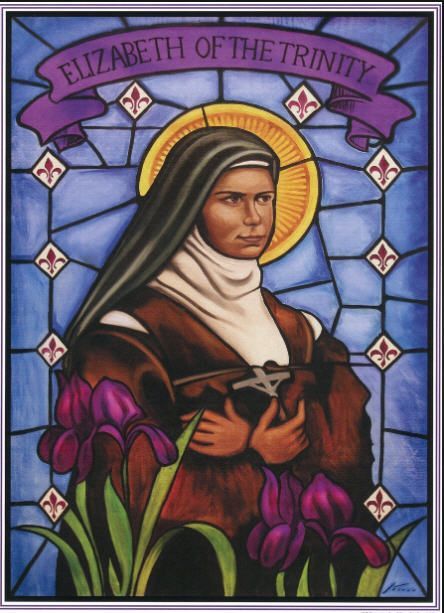
Saint Elizabeth Of The Trinity - November 8
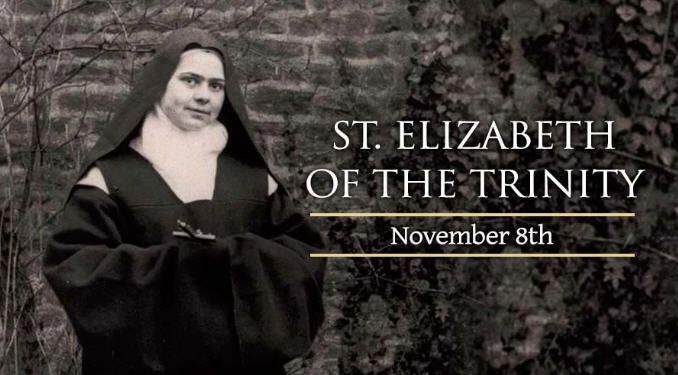
St. Elizabeth of the Trinity was born Elizabeth Catez in Bourges, France, in 1880. Her father, a military captain, died when she was only seven, leaving her mother to raise Elizabeth and her sister, Marguerite.
Elizabeth was a very lively girl and a gifted pianist, but was very stubborn and experienced fits of rage. However, even in her strong temperament she had a great love for God, and an early attraction to a life of prayer and reflection. She visited the sick often and taught catechism to children.
Against her mother's wishes, Elizabeth entered a monastery of Discalced Carmelites in 1901 at the age of 21. Though noted for great spiritual growth, she was also plagued with periods of powerful darkness which led her spiritual director to doubt her vocation. Nonetheless, she completed her novitiate and took her final vows in 1903. She died only three years later at the age of 26 of Addison’s disease. In her short life as a religious, she was a spiritual director for many, and she left a legacy of letters and retreat guides.
She is the patron of people who have lost their parents.
Saint Therese of Lisieux - October 1
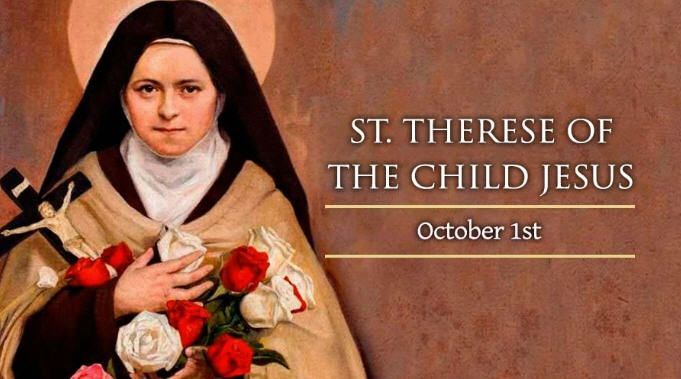
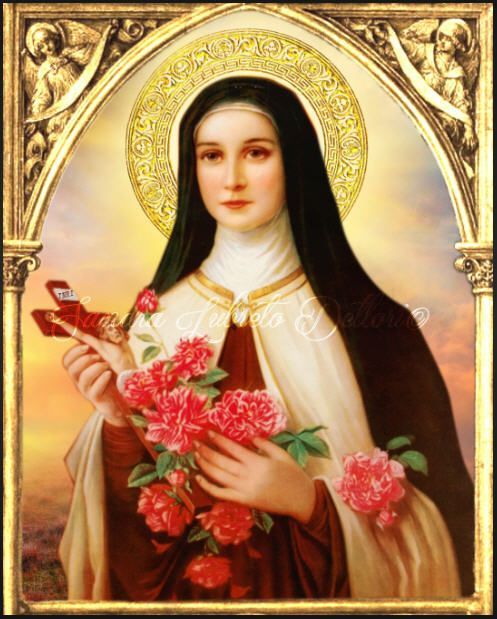
On October 1, Catholics around the world honor the life of St. Thérèse of the Child Jesus, or St. Thérèse of Lisieux on her feast day. St. Thérèse was born January 2, 1873 in Alençon, France to pious parents, both of whom are scheduled to be canonized in October 2016. Her mother died when she was four, leaving her father and elder sisters to raise her.
On Christmas Day 1886 St. Thérèse had a profound experience of intimate union with God, which she described as a “complete conversion.” Almost a year later, in a papal audience during a pilgrimage to Rome, in 1887, she asked for and obtained permission from Pope Leo XIII to enter the Carmelite Monastery at the young age of 15.
On entering, she devoted herself to living a life of holiness, doing all things with love and childlike trust in God. She struggled with life in the convent, but decided to make an effort to be charitable to all, especially those she didn’t like. She performed little acts of charity always, and little sacrifices not caring how unimportant they seemed. These acts helped her come to a deeper understanding of her vocation.
She wrote in her autobiography that she had always dreamed of being a missionary, an Apostle, a martyr – yet she was a nun in a quiet cloister in France. How could she fulfill these longings?
“Charity gave me the key to my vocation. I understood that the Church had a Heart and that this Heart was burning with love. I knew that one love drove the members of the Church to action, that if this love were extinguished, the apostles would have proclaimed the Gospel no longer, the martyrs would have shed their blood no more. I understood that Love comprised all vocations, that Love was everything, that it embraced all times and places...in a word, that it was eternal! Then in the excess of my delirious joy, I cried out: O Jesus, my Love...my vocation, at last I have found it...My vocation is Love!”
Thérèse offered herself as a sacrificial victim to the merciful Love of God on June 9, 1895, the feast of the Most Holy Trinity and the following year, on the night between Holy Thursday and Good Friday, she noticed the first symptoms of Tuberculosis, the illness which would lead to her death.
Thérèse recognized in her illness the mysterious visitation of the divine Spouse and welcomed the suffering as an answer to her offering the previous year. She also began to undergo a terrible trial of faith which lasted until her death a year and a half later. “Her last words, ‘My God, I love you,’ are the seal of her life,” said Pope John Paul II.
Since her death, millions have been inspired by her ‘little way’ of loving God and neighbor. Many miracles have been attributed to her intercession. She had predicted during her earthly life that “My Heaven will be spent doing good on Earth.”
Saint Thérèse was proclaimed a Doctor of the Church by Pope John Paul II in 1997 - 100 years after her death at the age of 24. She is only the third woman to be so proclaimed, after Saint Catherine of Siena and Saint Teresa of Avila.
St. Thérèse wrote once, 'You know well enough that Our Lord does not look so much at the greatness of our actions, nor even at their difficulty, but at the love with which we do them."
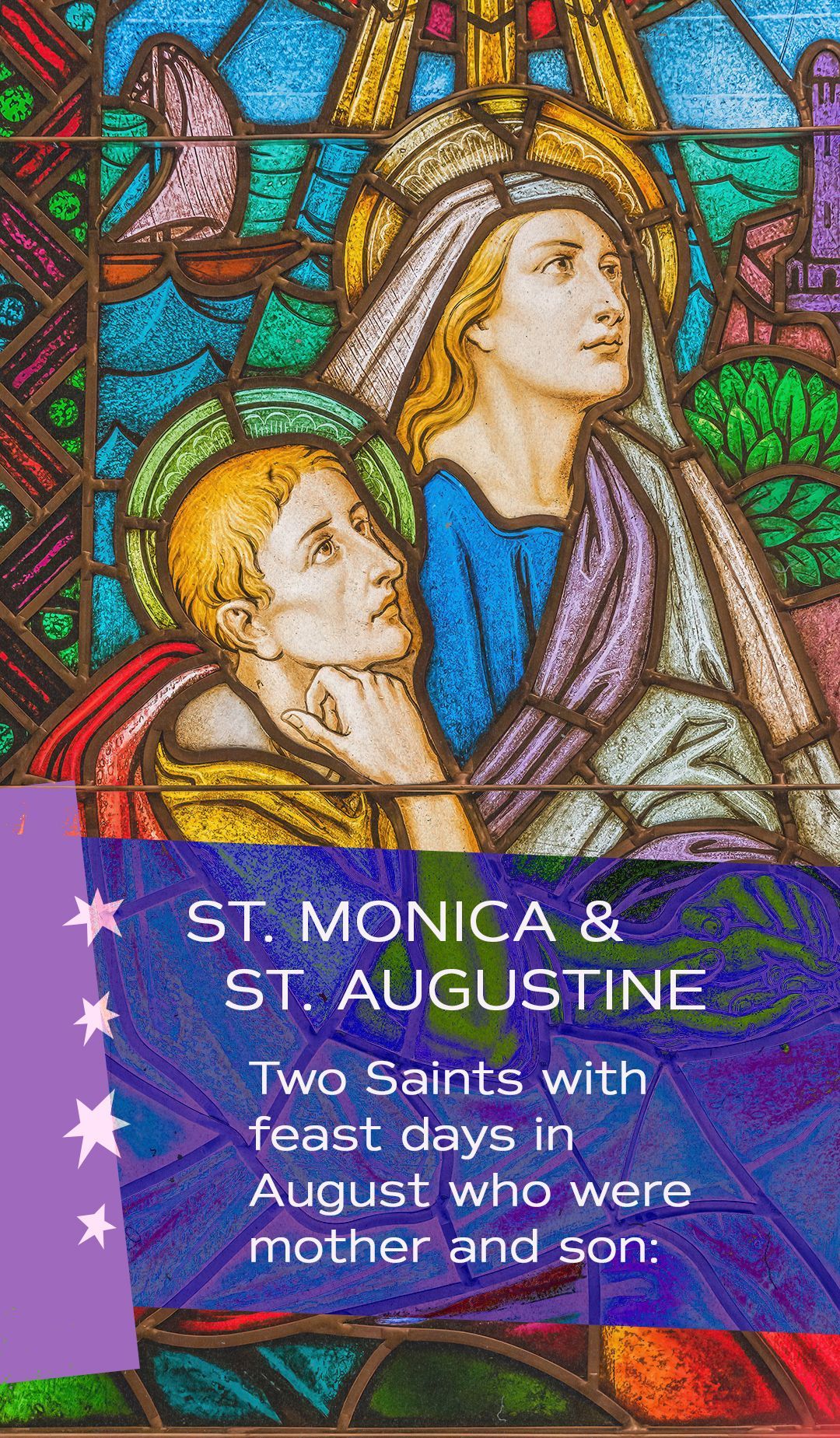
Mother and Son St. Monica and St. Augustine
August 27th and 28th
Holiness Runs in the Family
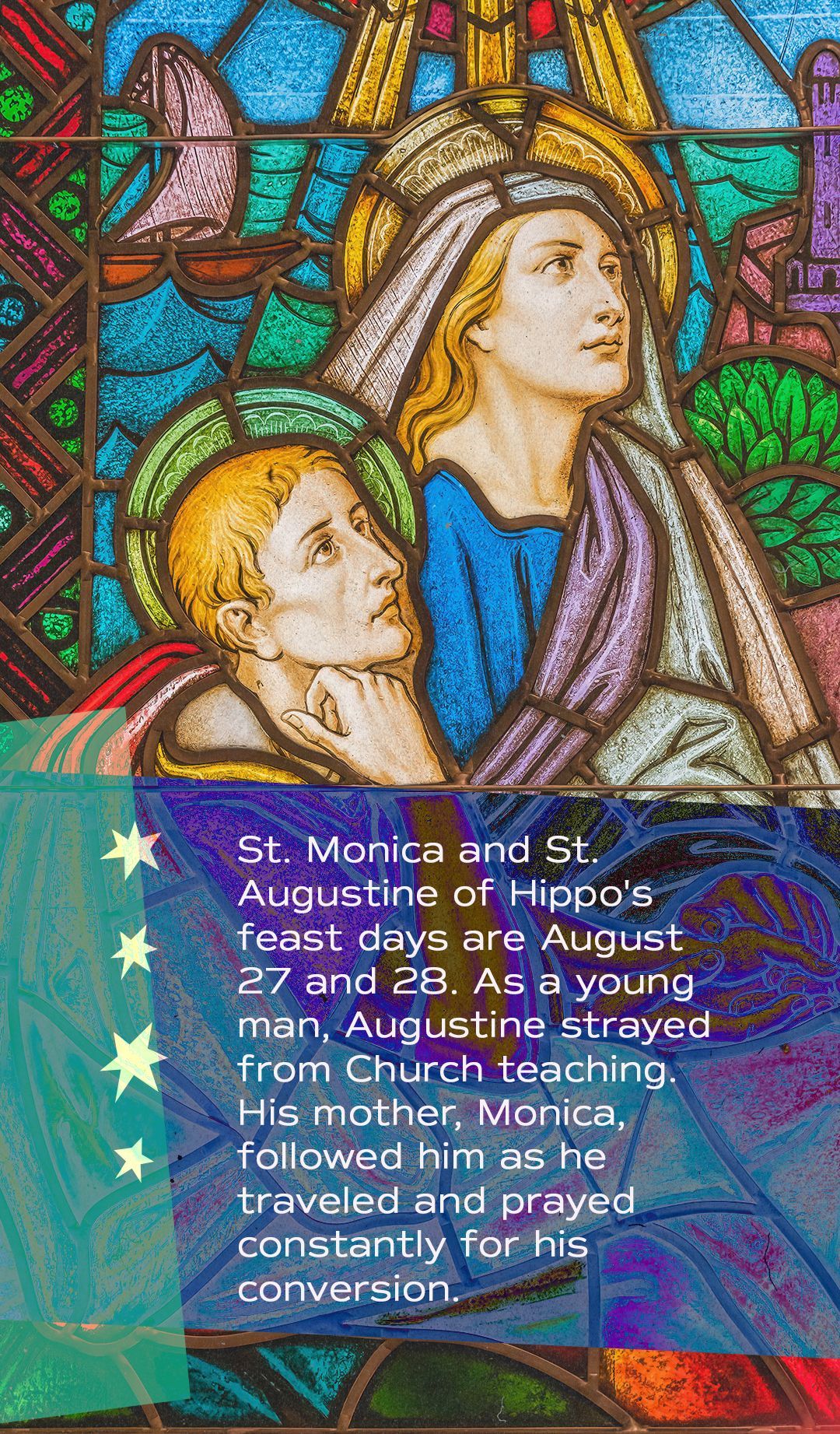
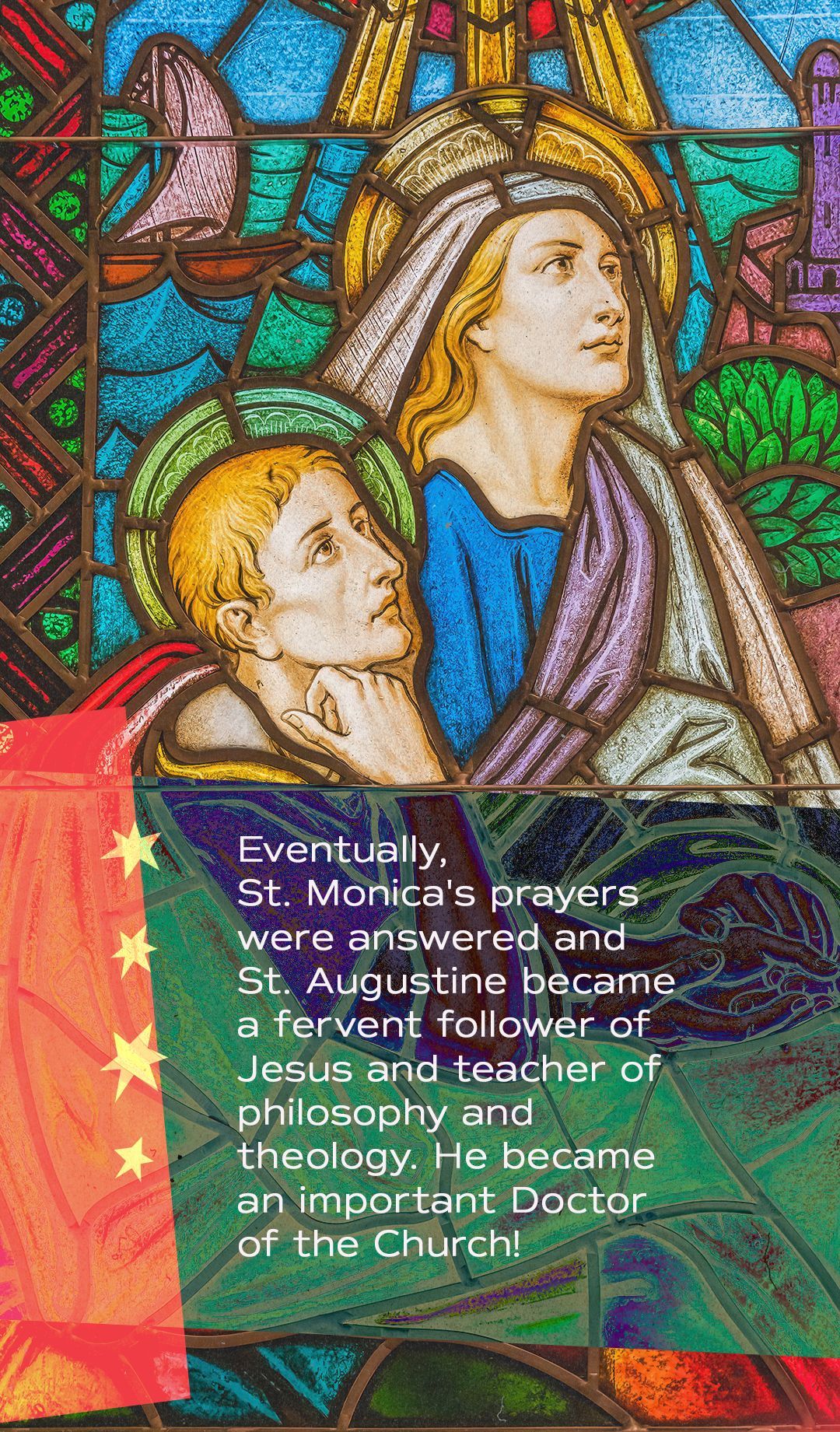
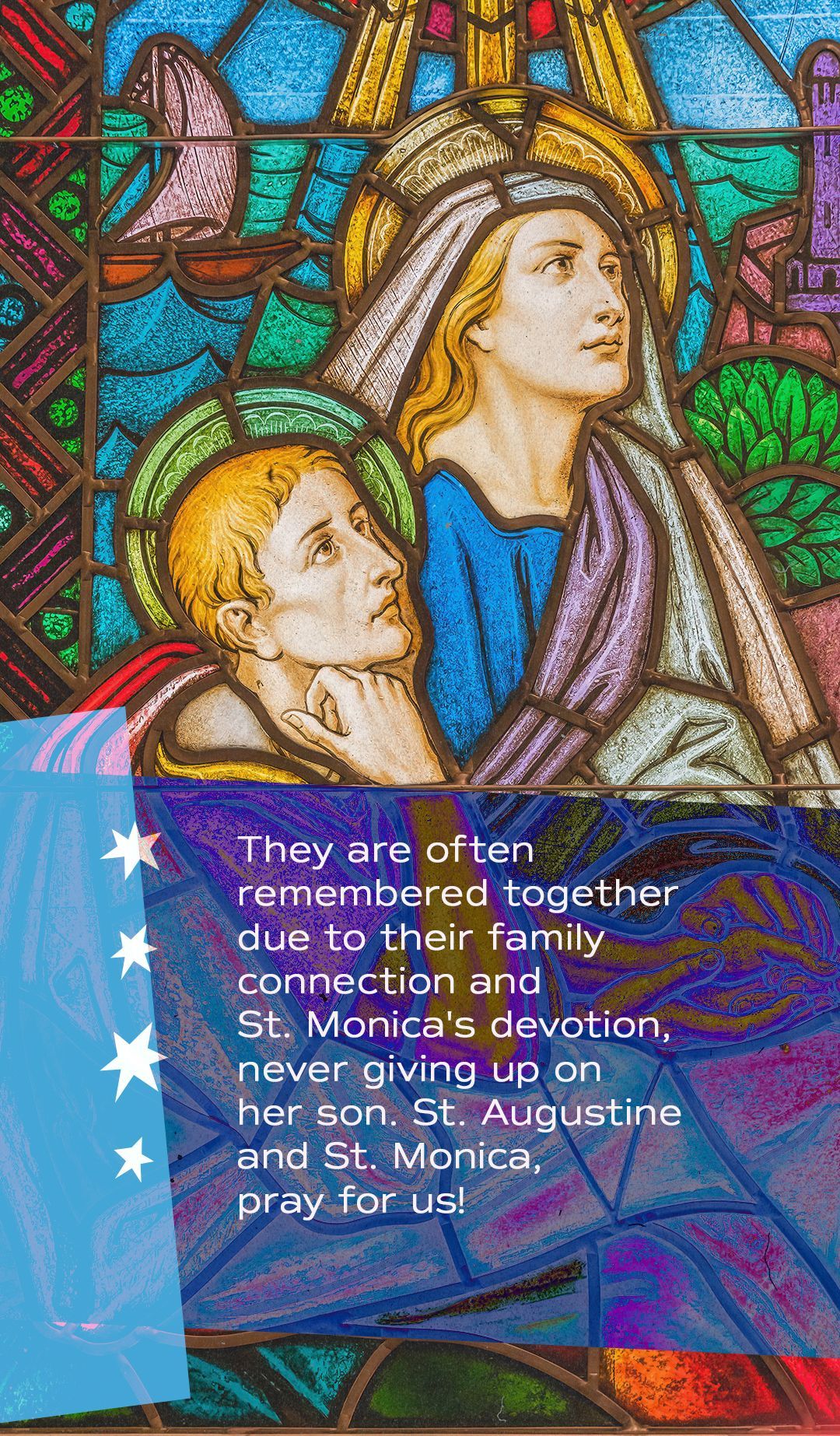
Raising faithful children is no easy task. For St. Monica, it seemed nearly impossible. Her husband wasn’t Christian and often mocked her faith. Their son, Augustine, fell quickly into wild ways. He and his friends drank, stole, and caroused throughout town. Monica never stopped praying for Augustine, no matter how far he strayed. Augustine became swept up in heresy, a false form of Christianity. He lived with a mistress and had a child out of wedlock. All the while, Monica kept praying. Conversion came slowly to Augustine, but at age 32, he was finally baptized. Augustine would go on to become a priest, then bishop, then world-renowned theologian whose works have stood the test of time. May St. Monica and St. Augustine inspire us to never stop praying for our loved ones.
Saint Augustine - August 28
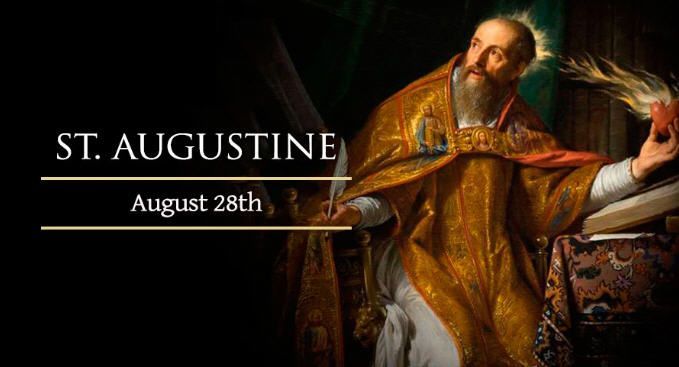
Today, August 28, the Church honors St. Augustine. St. Augustine was born at the town of Thagaste (now Souk-Ahras in modern day Algeria) on November 13, 354 and grew to become one the most significant and influential thinkers in the history of the Catholic Church. His teachings were the foundation of Christian doctrine for a millennium.
The story of his life, up until his conversion, is written in the autobiographical Confessions, the most intimate and well-known glimpse into an individual's soul ever written, as well as a fascinating philosophical, theological, mystical, poetic and literary work.
Augustine, though being brought up in early childhood as a Christian, lived a dissolute life of revelry and sin, and soon drifted away from the Church - thinking that he wasn't necessarily leaving Christ, of whose name he acknowledges "I kept it in the recesses of my heart; and all that presented itself to me without that Divine name, though it might be elegant, well written, and even replete with truth, did not altogether carry me away" (Confessions, I, iv).
He went to study in Carthage and became well-known in the city for his brilliant mind and rhetorical skills and sought a career as an orator or lawyer. But he also discovered and fell in love with philosophy at the age of 19, a love he pursued with great vehemence.
He was attracted to Manichaeanism at this time, after its devotees had promised him that they had scientific answers to the mystery of nature, could disprove the Scriptures, and could explain the problem of evil. Augustine became a follower for nine years, learning all there was to learn in it before rejecting it as incoherent and fraudulent.
He went to Rome and then Milan in 386 where he met Saint Ambrose, the bishop and Doctor of the Church, whose sermons inspired him to look for the truth he had always sought in the faith he had rejected. He received baptism and soon after, his mother, Saint Monica, died with the knowledge that all she had hoped for in this world had been fulfilled.
He returned to Africa, to his hometown of Tagaste, "having now cast off from himself the cares of the world, he lived for God with those who accompanied him, in fasting, prayers, and good works, meditating on the law of the Lord by day and by night."
On a visit to Hippo he was proclaimed priest and then bishop against his will. He later accepted it as the will of God and spent the rest of his life as the pastor of the North African town, where he spent much time refuting the writings of heretics.
Augustine also wrote, The City of God, against the pagans who charged that the fall of the Roman empire, which was taking place at the hands of the Vandals, was due to the spread of Christianity.
On August 28, 430, as Hippo was under siege by the Vandals, Augustine died, at the age of 76. His legacy continues to deeply shape the face of the Church to this day.
Saint Monica - August 27
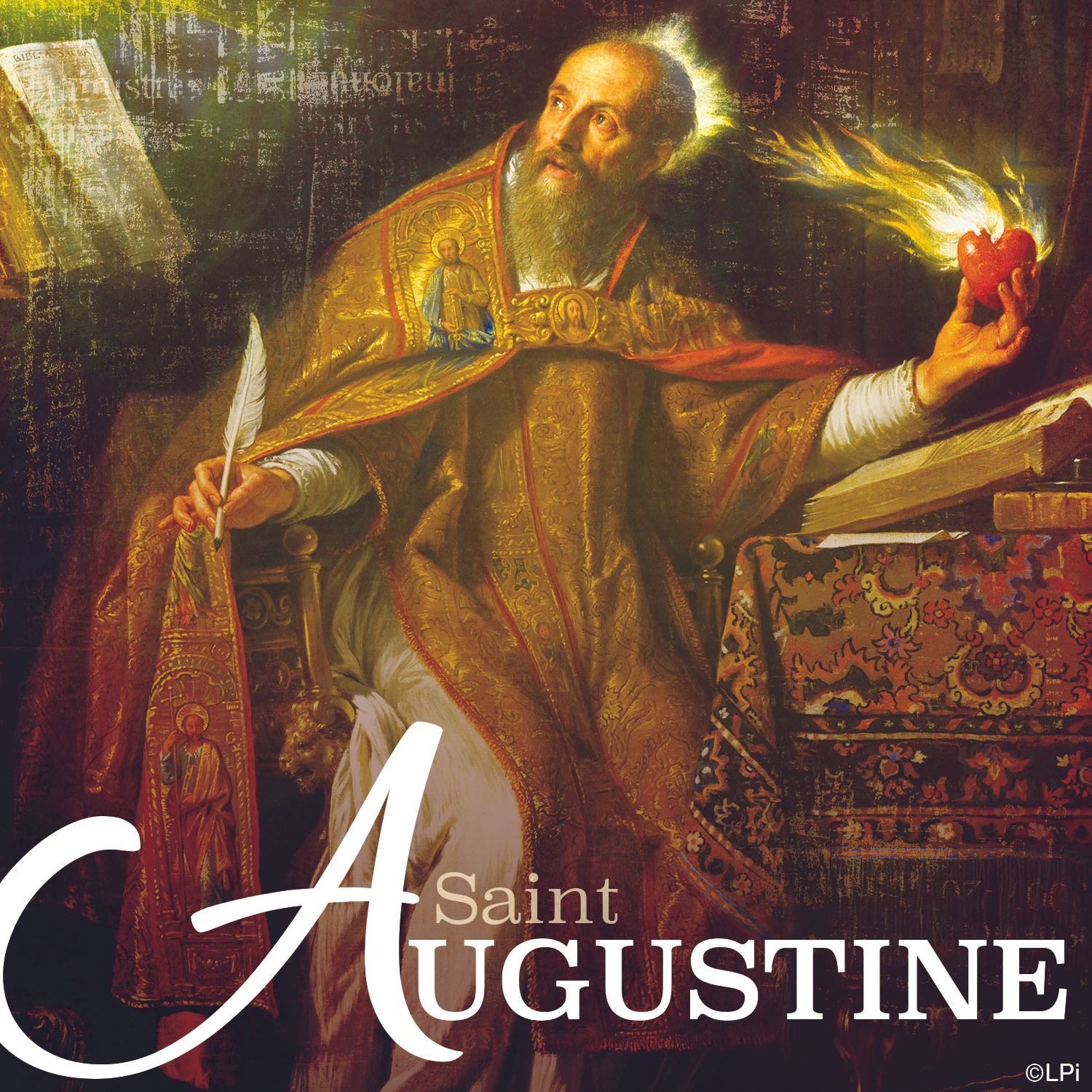
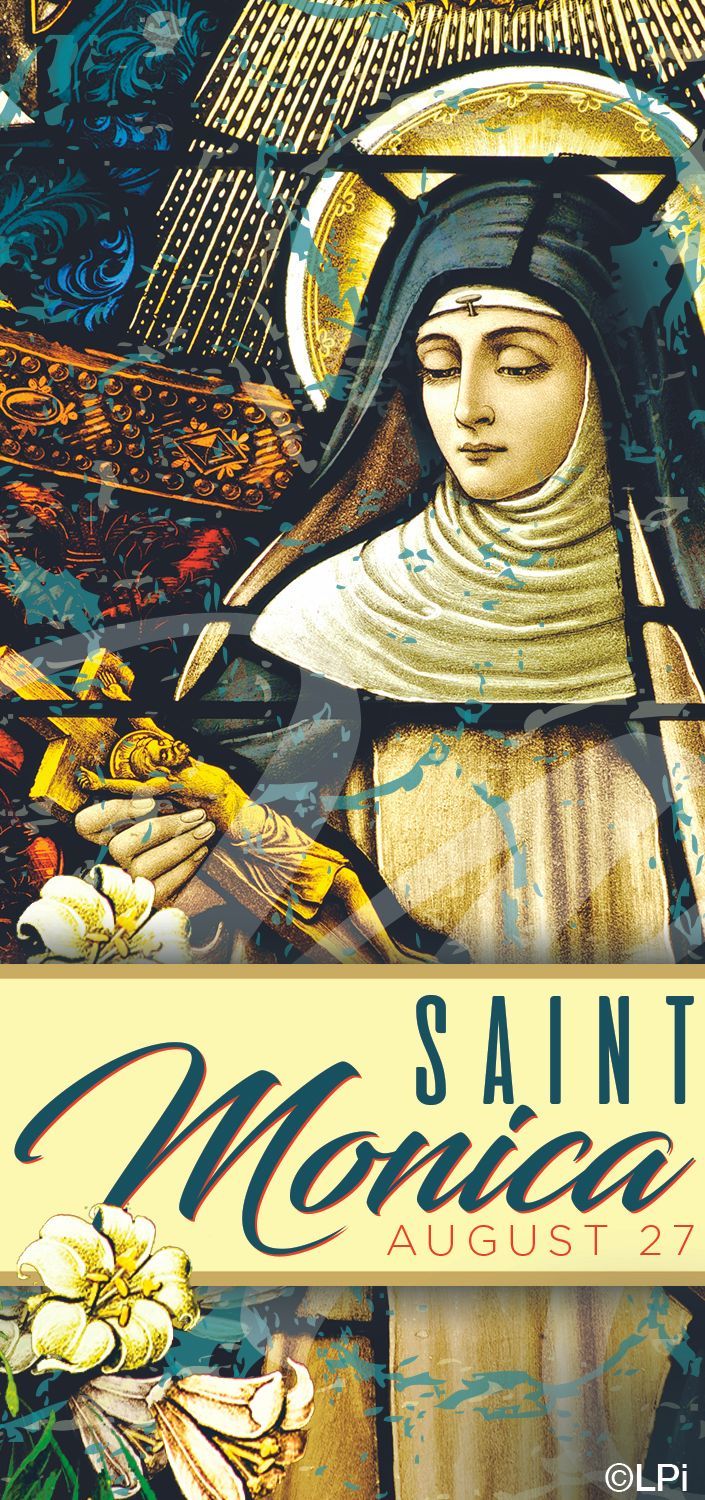
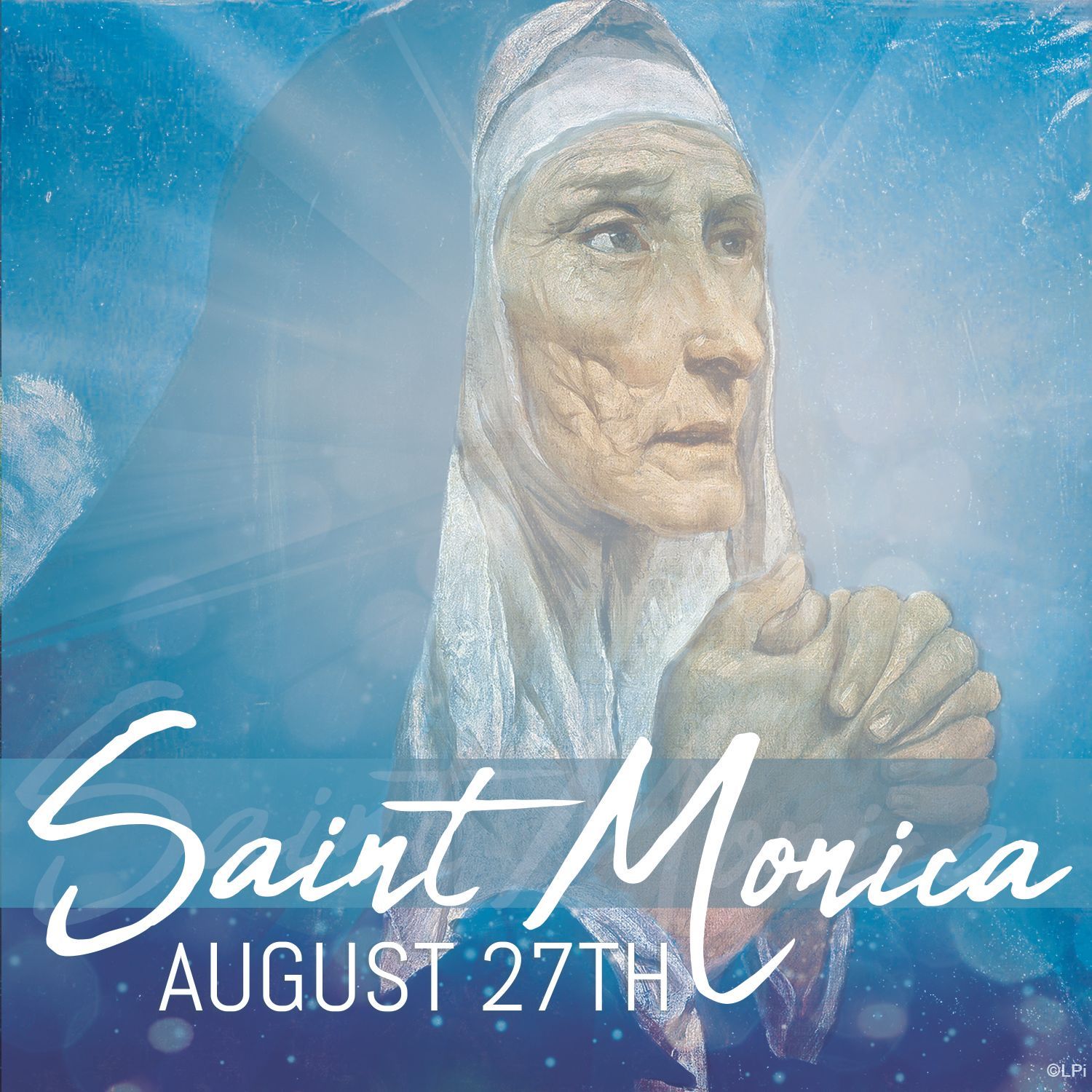
On Aug. 27, one day before the feast of her son St. Augustine, the Catholic Church honors St. Monica, whose holy example and fervent intercession led to one of the most dramatic conversions in Church history.
Monica was born into a Catholic family in 332 in the north African city of Tagaste, located in present-day Algeria. She was raised by a maidservant who taught her the virtues of obedience and temperance. While still relatively young, she married Patricius, a Roman civil servant with a bad temper and a disdain for his wife’s religion.
Patricius’ wife dealt patiently with his distressing behavior, which included infidelity to their marriage vows. But she experienced a greater grief when he would not allow their three children — Augustine, Nagivius, and Perpetua — to be baptized. When Augustine, the oldest, became sick and was in danger of death, Patricius gave consent for his baptism but withdrew it when he recovered.
Monica’s long-suffering patience and prayers eventually helped Patricius to see the error of his ways, and he was baptized into the Church one year before his death in 371. Her oldest son, however, soon embraced a way of life that brought her further grief. He fathered a child out of wedlock in 372 and a year later began to practice Manichaeism, a religion founded in the third century by the Parthian prophet Mani.
In her distress and grief, Monica initially shunned her oldest son. However, she experienced a mysterious dream that strengthened her hope for Augustine’s soul in which a messenger assured her: “Your son is with you.” After this experience, which took place around 377, she allowed him back into her home and continued to beg God for his conversion.
This would not take place for another nine years, however. In the meantime, Monica sought the advice of local clergy, wondering what they might do to persuade her son away from the Manichean heresy. One bishop, who had once belonged to that sect himself, assured Monica that it was “impossible that the son of such tears should perish.”
These tears and prayers intensified when Augustine, at age 29, abandoned Monica without warning as she passed the night praying in a chapel. Without saying goodbye to his mother, Augustine boarded a ship bound for Rome. Yet even this painful event would serve God’s greater purpose, as Augustine left to become a teacher in the place where he was destined to become a Catholic.
Under the influence of the saintly Bishop Ambrose of Milan, Augustine renounced the teaching of the Manichees around 384. Monica followed her son to Milan and drew encouragement from his growing interest in Ambrose’s preaching. After three years of struggle against his desires and perplexities, Augustine succumbed to God’s grace and was baptized in 387.
Shortly before her death, Monica shared a profound mystical experience of God with Augustine, who chronicled the event in his “Confessions.” Finally, she told him: “Son, for myself I have no longer any pleasure in anything in this life. Now that my hopes in this world are satisfied, I do not know what more I want here or why I am here.”
“The only thing I ask of you both,” she told Augustine and his brother Nagivius, “is that you make remembrance of me at the altar of the Lord wherever you are.”
St. Monica died at the age of 56 in the year 387. In modern times, she has become the inspiration for the St. Monica Sodality, which encourages prayer an
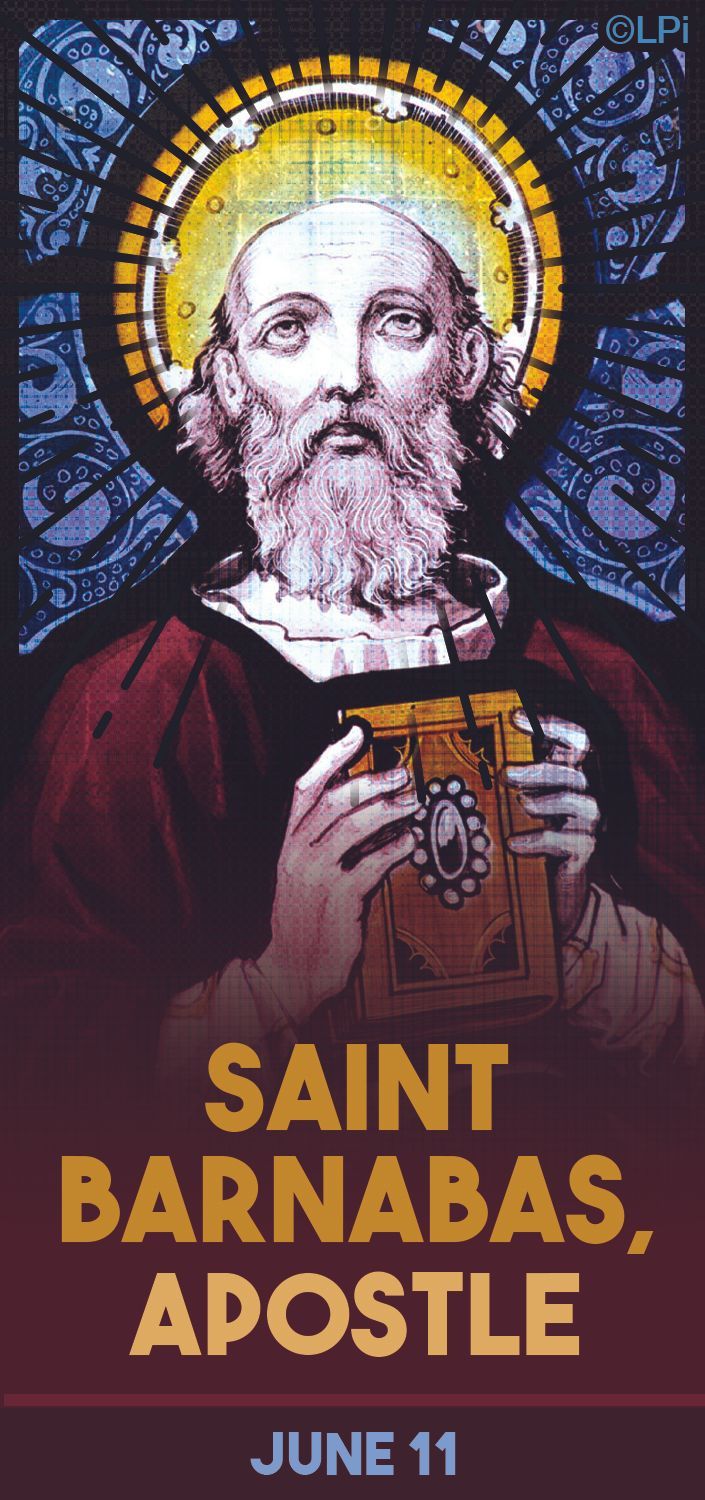
Saint Barnabas - June 11
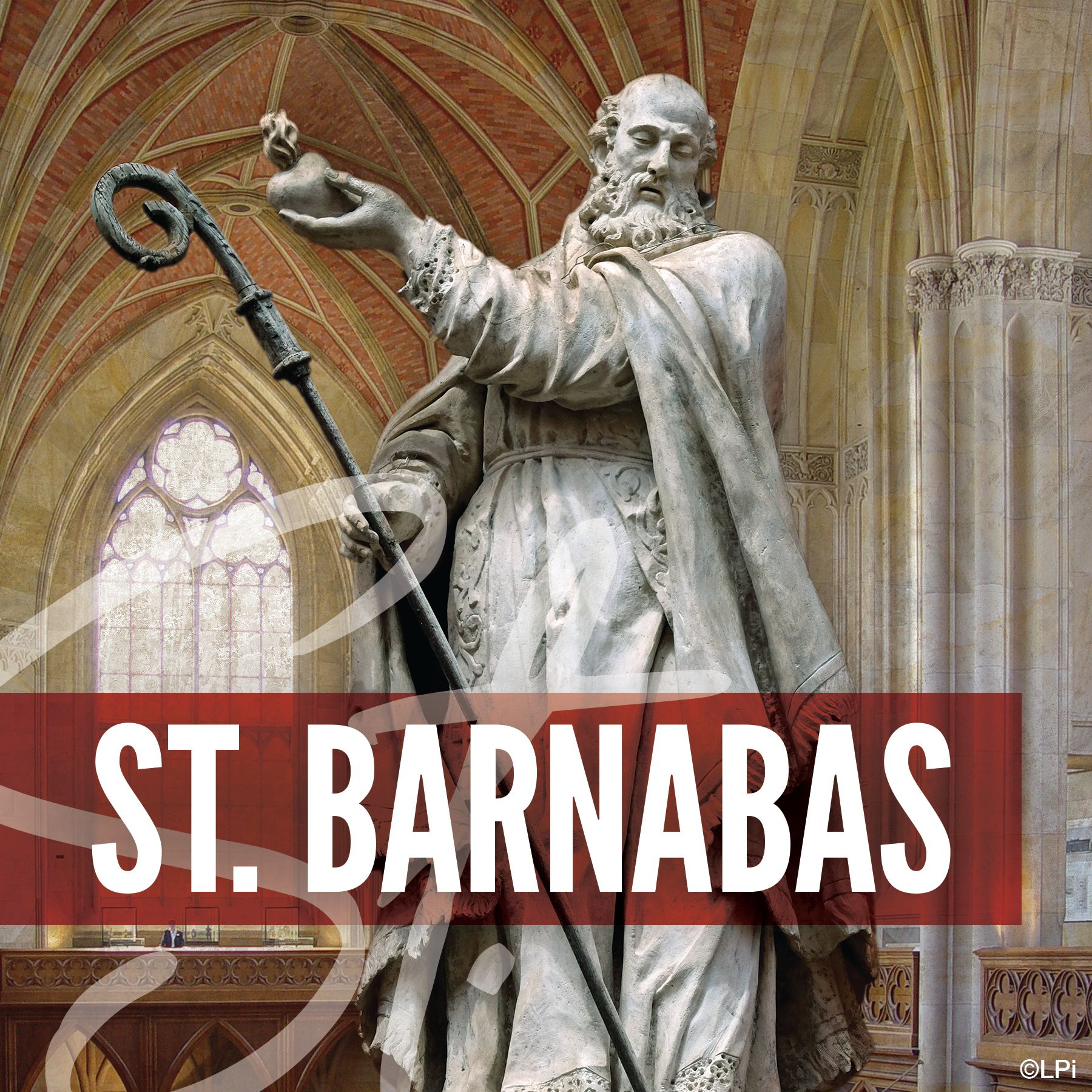
Catholics celebrate the memory of St. Barnabas on June 11. The apostle and missionary was among Christ's earliest followers and was responsible for welcoming St. Paul into the Church. Though not one of the 12 apostles chosen by the Lord, Jesus, he is traditionally regarded as one of the 72 disciples of Christ and most respected man in the first century Church after the Apostles themselves.
St. Barnabas was born to wealthy Jewish parents on the Greek-speaking island of Cyprus, probably around the time of Christ's own birth. Traditional accounts hold that his parents sent him to study in Jerusalem, where he studied at the school of Gamaliel (who also taught St. Paul). Later on, when Christ's public ministry began, Barnabas may have been among those who heard him preach in person. At some point, either during Christ's ministry or after his death and resurrection, Barnabas decided to commit himself in the most radical way to the teachings he had received. He sold the large estate he had inherited, contributed the proceeds entirely to the Church, and joined Christ's other apostles in holding all of their possessions in common. Saul of Tarsus, the future St. Paul, approached Barnabas after the miraculous events surrounding his conversion, and was first introduced to St. Peter through him. About five years later, Barnabas and Paul spent a year in Antioch, building up the Church community whose members were the first to go by the name of “Christians.” Both Paul and Barnabas received a calling from God to become the “Apostles of the Gentiles,” although the title is more often associated with St. Paul. The reference to the “laying-on of hands” in Acts, chapter 13, suggests that Paul and Barnabas may have been consecrated as bishops on this occasion.